Automated Hiring Systems Can Reject Qualified Candidates Before a Human Reviews Them
By Kato Tam
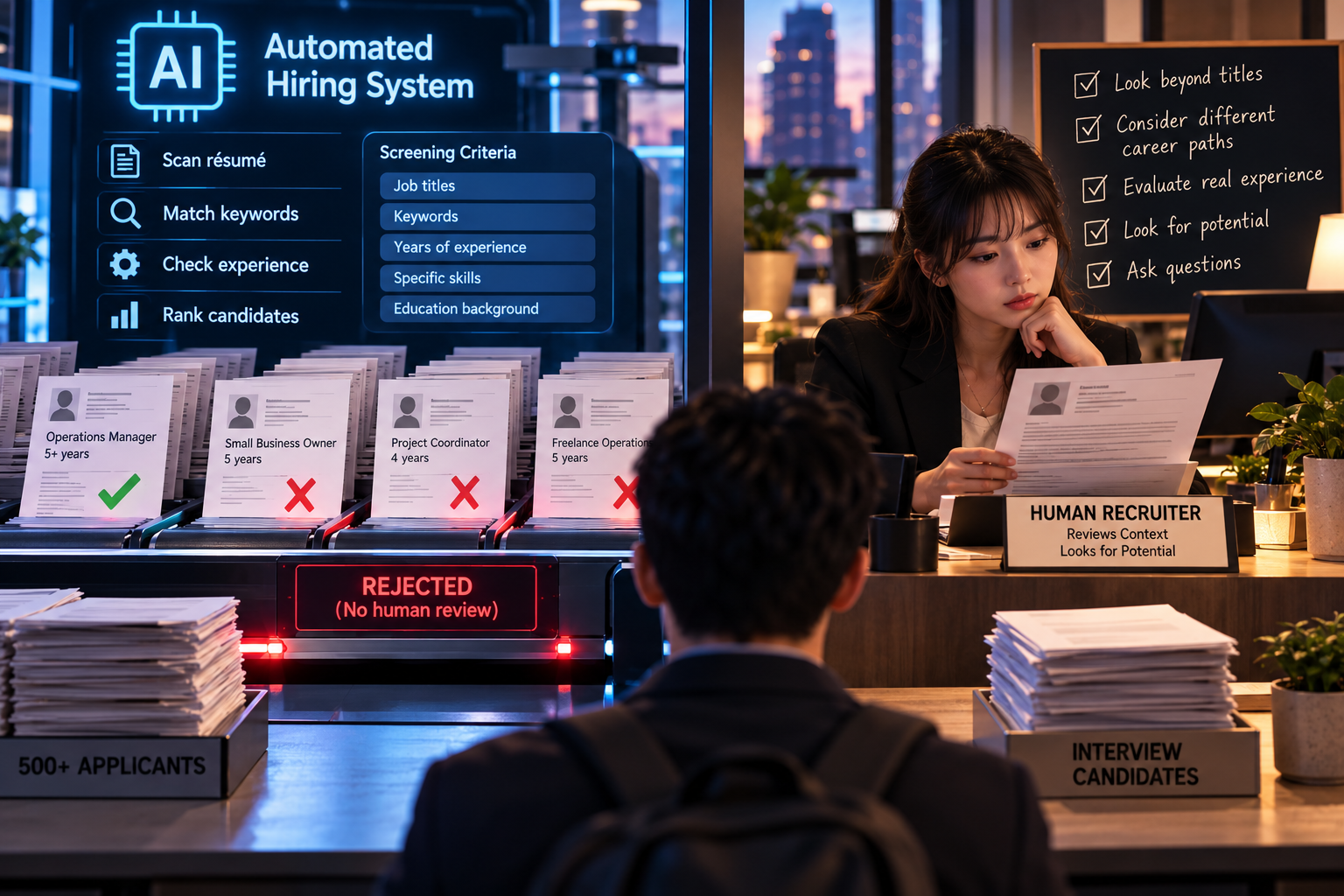
A job applicant can have the right experience, relevant skills, and a strong work history, yet still struggle to get an interview because their résumé never makes it through the company's screening process.
Hiring has always involved filtering people out. Recruiters cannot personally interview hundreds of applicants for every opening, so they narrow the field using experience, qualifications, and whatever else the employer considers important. The difference is that technology now helps make some of those decisions before a recruiter gets involved.
Automated hiring systems promise to make that process faster.
A company receiving 500 applications can use software to organize résumés, identify qualifications, rank applicants, or screen for specific requirements. Some tools simply help recruiters manage applications, while others use more advanced algorithms to evaluate candidates.
The problem is that recognizing qualifications is not always the same as recognizing potential.
Consider two people applying for an operations position. One has held the exact job title for five years, while the other has spent five years running a small business, managing budgets, coordinating vendors, handling contracts, and solving operational problems.
A human recruiter might recognize that both candidates have relevant experience, even though their careers look completely different on paper.
An automated system built around particular titles, keywords, or employment patterns might favor the first candidate.
That does not mean every automated hiring tool would make that mistake. It means the system's ability to recognize unconventional experience depends heavily on how it was designed and what information it evaluates.
A résumé can be a poor description of someone's actual ability.
Human recruiters have their own problems, of course. They can be inconsistent, overlook applicants, make assumptions about backgrounds, or favor candidates who resemble people they have hired before.
Automation can potentially reduce some of those inconsistencies by applying the same stated criteria across applications.
But consistency is not necessarily fairness.
Imagine an employer historically hired people from a narrow group of universities. If an automated model learns from those hiring decisions without appropriate safeguards, it could reproduce that preference even when university prestige has little connection to the work.
The system might apply the pattern consistently to thousands of people, making an old hiring habit much harder to notice.
There is another difference that matters to applicants.
When a human recruiter rejects someone, there is at least a person who made or approved the decision, even if the applicant never receives an explanation. When an automated screening process rejects someone, the applicant may not know whether a person reviewed their qualifications or whether a particular rule prevented their application from moving forward.
That uncertainty changes how people respond to rejection.
Someone who gets turned down by a recruiter might assume another candidate was more qualified. Someone who suspects software screened them out might start rewriting their résumé to satisfy keywords rather than communicate their actual experience.
Eventually, applicants can end up writing for the screening system instead of the employer.
Hiring software changes not only how companies evaluate people, but also how people present themselves to companies.
The strongest argument for automated hiring is not that software understands candidates better than recruiters. It is that technology can handle repetitive screening tasks and help recruiters spend more time evaluating people who deserve closer consideration.
That distinction should guide how employers use it.
A system that flags potentially relevant applicants for human review serves a different purpose from one that automatically eliminates people based on narrow signals. Both can save time, but they place the risk of an imperfect decision in very different places.
Hiring has never been a perfect science, whether the decision comes from a person or a computer.
The real question is whether automation helps employers recognize more qualified people or simply allows them to reject applicants faster.
Speed is useful, but it should not become the measure of a good hiring decision.